Showing posts with label Sharing The Planet. Show all posts

Thursday, 12 May 2016

Summative Task


You have 6 blocks in class to complete this:

  • 1 on Thursday Week 2
  • 3 on Friday Week 2
  • 2 on Monday Week 3
Presentation of your ideas will be on Tuesday Week 3. We will then reflection where we are at on the SAT (Summative Assessment Task) rubric.

Letter/story/essay:
Holly and Ryan

Video/iMovie:
Kaelim, Jack D, Jason, Dylan

Poster:
Amy, Tiana, Annabelle, Kayla

Poster 2:
Darbie, Juliet, Libby, Waimere

Poster 3 Video/iMovie 2
Jack M, Jake, Kyle, Damian

Pamphlet:
Fiona, Ting-wei, Giorgia, Aysha

Pamphlet 2:
Emelia, Molly, Alycia, Lucy

Pamphlet 3:
Alycia, Lucy

Blog:
Christian, Tyler


Morgan to join a group (away)
Sami to help others (not at camp)


Monday, 25 April 2016

Holidays: Camp Prep in action


I had an opportunity to use what we had learnt from our camp preparation programme.

We were on the way home from Taranaki, and we decided to stop by an isolated beach. It was quite cold (hence Mrs Ahie's scarf and Josef's hoodie). We thought we just had to put our toes in the water before heading back to the beachless Hamilton.

The water was freezing, so we didn't aim to stay long.

Alas, we turned our heads for a couple of seconds, and Josef ran as fast as he could into deeper water... landing face first.

Thankfully, we had a little merino shirt and a woolen jersey to get him into. We stripped off his cotton (as that would have maintained the cold even with the merino and wool on), got him into his warm clothes, and into the car (with the heater on). He is now nice and healthy, and he didn't even get a runny nose.

It is always encouraging to use what one has learnt. Have you been able to use what you have learnt during the term and apply it these holidays? If so, I would love to hear from you. 

Enjoy your last week of holidays. 


Holidays: Sharing the Planet

I was hanging out washing for my mother and wondered how all this plastic got in the washing. Turns out she washes it and recycles it. It reminded me of our current unit. Good job, mamma!

Have you been able to help the planet in some way over the holidays or since we began the unit? Let me know.

Science: Making dirty water clean

Add caption

Camp Prep: Big walk around the field

Thursday, 14 April 2016

Dorm Groups

The moment you have all been waiting for... just a reminder to be supportive and open-minded. I believe everyone in the class got someone they wanted in either their duty group or dorm group, so be grateful :)


Using a Compass


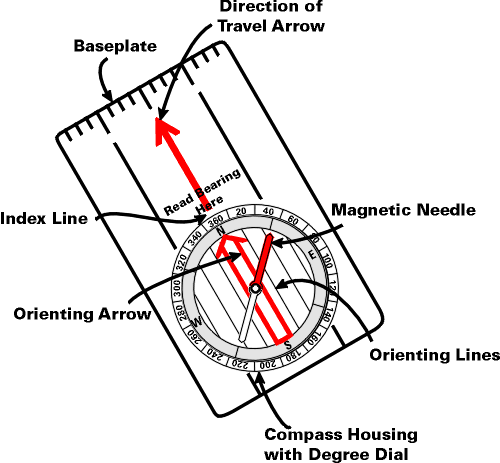
Instruct in use of compass
  • Ø Careful handling of compass – do not drop or hit, keep away from magnetic interference, report damage to TIC

  • Ø Give simple, short, clear instructions for orienting compass
    o Rotate dial to given bearing
    o Base plate held horizontally at tummy button level
    o Direction of travel arrow pointing away from tummy
    o Align Magnetic North arrow (needle) and Orienting Arrow (Red into Shed)
    by rotating SELF – not compass
    o Direction of travel arrow shows where to aim for.

  • Ø Give bearing and ask students/adults to orient themselves

  • Ø Check all students/adults are facing the correct direction

  • Ø Practice setting buddy into position and do back-bearing check 

Put the Red in the Shed.
Aim the direction of travel arrow at the person

Monday, 11 April 2016

A Big Walk In idea

I found this video; do you think it would be worth trying for the whole big walk into camp? Add a comment to let me know your thoughts. I believe our school owns a Go-Pro.

Clothing for Camp

Look at a variety of clothing, group decide if it is good/bad or necessary to take. 

Cotton or Polyester:

  • (t-shirt, hat, jeans, singlet, shirt)
  • fine if dry, lethal if wet – accelerates heat loss, leading to hypothermia
  • jeans inappropriate in bush, okay in lodge

Wool, Merino 

  • (socks, jumper, hat, singlet, shirt) 
  • excellent when wet - retains warmth
  • can be bulky – (newer merino garments not bulky but expensive)

Polyprop/thermals
  • (thermal longjohns, short or long-sleeved tops, socks, hats) 
  • excellent when wet – dries quickly
  • light, thin - easily carried
  • thin layers allow for temperature control
  • longjohns can be worn under shorts in cooler weather/ in river

Polar Fleece (vest, jumper, jacket, pants)
  • excellent when wet – retains warmth & dries quickly
Rain jacket
  • One that holds out water if put under a tap


Create a best dressed & worst dressed person.
Write or draw onto body outline articles of clothing that are needed for walking in the bush.


Wasps


A wasp can sting many times. They do not leave a sting like bees do, so it is not possible to remove the venom once a person has been stung.
In areas with wasps, many people get stung more than once. Therefore, move away from the area quickly and calmly before beginning treatment.

Where are wasps?

  • Wasps defend their nests.
  • Nests are usually close to or at ground level, near the bush edge and in
    clearings. A water source is often nearby.
Warning Signs
  • Wasps travel at high speed and in a straight line when going in and out of their nest. That is your warning you are near a nest.
  • If safe to do so, stop and observe to locate the nest and take a wide detour to avoid it.
Walk to avoid upsetting wasps
  • Don’t bash the bushes and grasses along the sides of the track.
  • Don’t overtake others by crashing through the sides of the track.
  • Often the front of the line will stir up the nest but people further
    back will get stung.
Action if attacked
  • Quickly and calmly move away from the area. The wasps will only follow you until you are away from the nest.
  • Warn others behind you about the nest.

Treatment
  • When safe, sit patient down, keeping them quiet and still.
  • Put something cold on the sting site to help relieve the pain.
  • Give the patient an antihistamine tablet (it will take 20 mins to work)
  • Watch for symptoms of anaphylaxis (administer adrenaline if
    appropriate)
  • Have patient rest until they have recovered, before they resume
    activity. 

Friday, 8 April 2016

Camp Prep: Is there a doctor in the tent?


Embed this image to your blog:


<iframe src="https://drive.google.com/a/berkley.school.nz/file/d/0B6Chw8PLQ8ZjVDV0SkVTUE5UUm8/preview" width="640" height="480"></iframe>

Read through it and answer the following questions underneath it:

1. SEE: Summarise each section under the headings

2. THINK: What do you think is the most helpful piece of information on this to someone who is going on camp?
3. THINK: What was something you have learnt from this?
4. WONDER: Do you have any questions that has come from this reading?
4. So what?: How is this relevant to camp?
4. So what?: How is this relevant to our current transdisciplinary theme? (Sharing the Planet)

Add three labels to this post: Sharing the Planet, Camp, Reading

  • Extras for Experts: Write a reflection on your time helping Room 1
  • Complete the new student blogging challenge
  • Update what you have done for "Take up the Challenge"

Wednesday, 6 April 2016

Camp Prep: Hypothermia


Camp Prep: Going Bush


So what?

How is this relevant to our camp and our transdiciplnary theme? (Sharing the Planet)

Blogs: Wed 6th April


Embed this image to your blog:


<iframe src="https://drive.google.com/a/berkley.school.nz/file/d/0B6Chw8PLQ8ZjRnNQZlBTOXlvSFE/preview" width="640" height="480"></iframe>

Read through it and answer the following questions underneath it:

1. What do you notice about the layout of this?

2. Why would it be set out this way rather than just have text?
3. So what?: How is this relevant to camp?
4. So what?: How is this relevant to our current transdisciplinary theme? (Sharing the Planet)

Add three labels to this post: Sharing the Planet, Camp, Reading

Thursday, 31 March 2016

The Outdoor Safety Code

The New Zealand Mountain Safety Council encourages the use of The Outdoor Safety Code across all outdoor activities, sports and recreations.


• Plan your trip
Seek local knowledge, plan the route you will take and the amount of time you can reasonably expect it to take.

• Tell someone 
Tell someone your plans and leave a date for when to raise the alarm if you haven’t returned.

• Be aware of the weather 
New Zealand’s weather can be highly unpredictable.  Check the forecast and expect weather changes.

• Know your limits
Challenge yourself within your physical limits and experience.

• Take sufficient supplies
Make sure you have enough food, equipment and emergency rations for the worst case scenario. Take an appropriate means of communication.
The 5 safety points above have been created through expert consultation and are the core to all outdoor safety practices.

All of the points can be expanded upon depending on your specific recreation and geographic location, so use them as a starting point and make sure you know all you can about your activity before you head out.


Click here for the full website here

Thursday, 24 March 2016

Title Page: Sharing the Planet

Task: Create a title page with the following information.

Unit Title - Sharing The Planet

Central Idea - We are the guardians of our planet's resources

Lines of Inquiry
- The Earth's resources and their limited nature
- Personal choices impact the environment
- Sustaining resources for future generations

Key Concepts - Perspective &Causation

Learner Profile - Principled, Caring & Knowledgeable

Attitudes - Curiosity, Commitment & Appreciation

TD Skills - Thinking, Research & Communication

Full Name
Room 14Rangahau
Discussion: What should the title page look like?

To some extent, this is a matter of personal style. However, there are some general guidelines to follow:

1. Use only one or two fonts. More than two can be confusing to read.

2. Use a clear font that is easy to read.

3. Keep it simple. Too many words or pictures can have a distracting or confusing effect.

4. Keeping all of the lines starting on either the left or right margin is easier to read and creates a stronger visual impression than centered text or random placement. The first example shows the text lined up on the left margin and the second shows the text lined up on the right margin.

5. If you would like to add a graphic (picture), use one that doesn't overpower the text because it is too big, or so small that it isn't clear. Or, you could do a large background graphic in a lighter coloured ink. That would also be attractive and appropriate. Just make sure there is contrast between the background and the words so that the words are readable.

Check out the following website for some awesome ideas!

Camp Numbers, Duty Groups, Activity Groups


Friday, 18 March 2016

UOI2: Unpacking the LOIs (tuning in)

Unpack the LOIs (just like with the CI)

Define:

LOI 1: limited nature
LOI 2: personal choices, impact, environment
LOI 3: sustaining, future generations.

Note: Remember the context will influence the definition

So what?

Answer for each LOI: What does this mean for me? 

UOI2: Unpacking the C.I. (tuning in)